
Diagnosis for Obsessive-Compulsive Disorder (OCD) in Adults: A Compassionate Path to Clarity
Expert psychiatric evaluation, evidence-based therapy, and medication management for adults (18+) across Massachusetts and Rhode Island. Regain control from intrusive thoughts with SNBCare.
Schedule Your Evaluation TodayWhat is Obsessive-Compulsive Disorder? Understanding the Clinical Diagnosis
Obsessive-Compulsive Disorder (OCD) is a chronic and long-lasting medical condition in which an individual has uncontrollable, reoccurring thoughts (obsessions) and/or behaviors (compulsions) that they feel an intense urge to repeat. For many adults, receiving an official diagnosis of OCD is the first time their internal struggle is validated by medical science.
Having OCD is not simply a personality trait about being tidy, pedantic, or organized. It is a specific biological condition involving the brain’s “error detection” circuitry. When this circuit is hyperactive, it signals that something is wrong—even when it isn’t—leading to intense anxiety that can only be relieved, temporarily, by performing a compulsion.

The Cycle of Obsessive-Compulsive Disorder
The cycle of symptoms typically follows four stages: Obsession (the intrusive thought), Anxiety (the distress caused by the thought), Compulsion (the ritual performed to lower anxiety), and Relief (the temporary calm before the next obsession starts). Breaking this loop requires a specialized diagnostic and treatment approach.
Are intrusive thoughts consuming your day? Our specialists offer comprehensive evaluations to help you understand your symptoms.
Get Evaluated NowRecognizing the Signs: Common Symptoms and Red Flags
An accurate diagnosis of OCD depends on identifying specific patterns of obsessions and compulsions. Because the condition is sometimes referred to as “the doubting disease,” adults often second-guess whether their symptoms are “severe enough” to seek help. However, if your thoughts or rituals consume more than one hour per day and cause significant distress, professional help is recommended.

| Type of Symptom | Examples for Adults | Impact on Life |
|---|---|---|
| Obsessions | Intense fear of contamination, violent intrusive thoughts, overwhelming need for symmetry. | Constant mental fatigue and high anxiety. |
| Compulsions | Excessive cleaning, repetitive checking of locks, silent mental counting. | Delayed schedules and physical exhaustion. |
| Avoidance | Refusing to use public restrooms, avoiding specific social interactions or objects. | Social isolation and limited career growth. |
Is your routine feeling like a trap? We prioritize fast access to care, with appointments often available within a week.
Schedule a ConsultationCauses and Biological Factors: Why the Condition Occurs
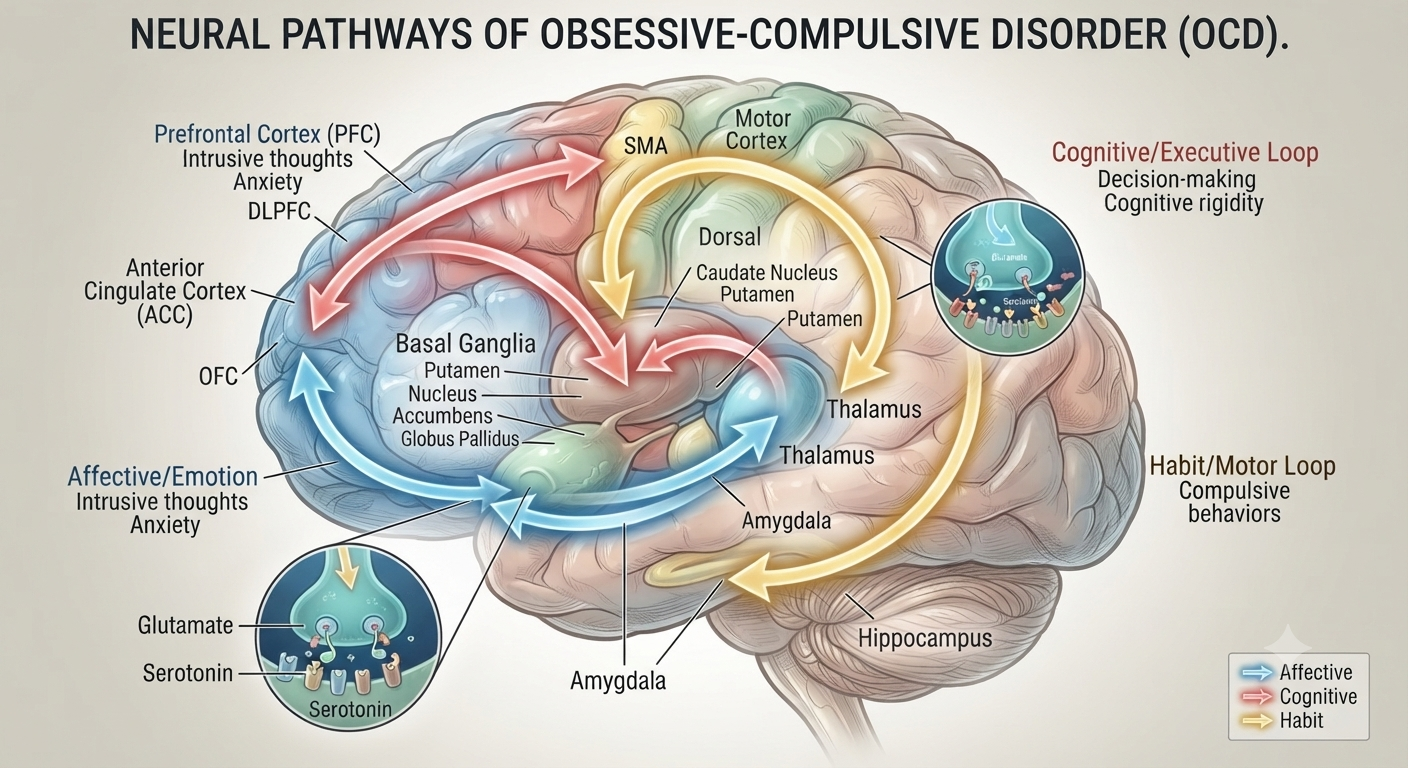
A frequent question during an evaluation for OCD is, “Is this my fault?” The answer is a definitive no. Obsessive-Compulsive Disorder is the result of a complex interplay between genetics, brain structure, and environment. Research suggests that the communication between the front part of the brain and deeper structures (such as the basal ganglia) is disrupted in individuals who have OCD.
- Genetics: Adults with a first-degree relative who has OCD are at a statistically higher risk.
- Brain Chemistry: Imbalances in neurotransmitters like serotonin and glutamate play a critical role.
- Environment: While stress does not directly cause the condition, it can act as a trigger or worsen existing symptoms.
Understand the biological root of your struggle. Our multidisciplinary team looks at your complete health picture.
Talk to a SpecialistThe Diagnostic Process: What to Expect During Evaluation
Receiving a formal diagnosis of Obsessive-Compulsive Disorder at SNBCare is a collaborative and thorough process. We use the criteria established in the DSM-5 (Diagnostic and Statistical Manual of Mental Disorders) to ensure clinical accuracy. Unlike general practitioners, our psychiatric specialists are specifically trained to spot the subtle nuances of obsessive-compulsive themes.

| Step | Clinical Action | Patient Goal |
|---|---|---|
| Clinical Interview | Review of comprehensive medical and psychological history. | Establish a shared understanding of the condition’s impact on daily life. |
| Symptom Mapping | Identifying the exact nature of the obsessions and compulsions. | Determining the specific manifestation or subtype of the condition. |
| Medical Screen | Ruling out thyroid issues or other underlying medical causes. | Ensuring an accurate, pure psychiatric diagnosis. |
Ready to take the first step toward clarity? We offer both in-person and secure telehealth evaluations.
Book Your EvaluationExploring Manifestations: Mental Compulsions, Contamination, and Beyond
Obsessive-Compulsive Disorder is not a one-size-fits-all condition. During your evaluation, we identify the specific ways the condition manifests for you. This is critical because therapy must be directly tailored to your unique, underlying fear themes.

Some adults experience “Pure O” (Purely Obsessional), where compulsions are mental—such as silent reviewing or counting—rather than physical acts like handwashing. Others may struggle with intrusive thoughts regarding the physical safety of loved ones, or “Scrupulosity,” which centers on overwhelming moral or religious fears.
Uncertain about the nature of your intrusive thoughts? Let our psychiatric experts provide a precise diagnosis.
Consult an ExpertEvidence-Based Therapy: Exposure and Response Prevention (ERP)
The gold standard treatment following a diagnosis of OCD is ERP therapy. Unlike traditional unstructured talk therapy—which can sometimes inadvertently worsen symptoms by providing reassurance—ERP actively helps you face your fears without resorting to your compulsive rituals.

- Gradual Exposure: Confronting small, manageable fears first before moving to larger ones.
- Response Prevention: Learning the skills to sit with anxiety without utilizing compulsive rituals for relief.
- Habituation: The biological process where the brain naturally learns to calm down over time when exposed to the trigger.
Reclaim your time from draining rituals. Our therapists specialize in the latest ERP and Cognitive Behavioral Therapy techniques.
Find a TherapistMedication Management: Supporting Your Recovery
For many adults, carefully managed medication is a vital component of treatment. After you receive a clinical diagnosis for OCD, our psychiatric providers may recommend specific medications, such as SSRIs (Selective Serotonin Reuptake Inhibitors), to help lower the frequency and volume of intrusive thoughts, making behavioral therapy much more effective.

| Medication Class | Typical Clinical Use | How It Helps Individuals with OCD |
|---|---|---|
| SSRIs | Often requires higher therapeutic doses than when treating depression alone. | Reduces the intensity and persistence of intrusive, obsessive thoughts. |
| Tricyclics | Considered when SSRIs do not yield a fully effective response. | Targets deep-seated obsessional neurological patterns. |
Interested in exploring a safe medication plan? Our board-certified providers accept major health insurance plans.
Schedule Med EvaluationDaily Coping and Long-Term Wellness
Living with a diagnosis of Obsessive-Compulsive Disorder is an ongoing journey. Beyond formal medical treatment, healthy lifestyle adjustments such as mindfulness practices, consistent restorative sleep, and reducing caffeine intake can help stabilize your nervous system and significantly reduce the frequency of symptom flare-ups.

Want to build a personalized toolkit for daily wellness? Connect with the SNBCare clinical team today.
Contact SNBCareTelehealth: Accessible Psychiatric Care from Your Home
We firmly believe that your geographic location should not prevent you from receiving a world-class evaluation for OCD. Our highly secure, HIPAA-compliant telehealth platform allows adult patients located anywhere in Massachusetts and Rhode Island to receive expert evaluations and ERP therapy from the privacy of their own homes.

Prefer the convenience of virtual care? Our telehealth sessions provide the exact same high standard of care as in-person visits.
Book Telehealth SessionWhy Choose SNBCare for Your Mental Health Journey?
At SNBCare, we treat adults (18+) living with mental health conditions with deep compassion and clinical excellence. We understand that mental health is equally as important as physical health, and we are dedicated to providing a patient-first environment where you feel actively heard, respected, and supported.

- Expert Team: Board-certified psychiatric providers and extensively licensed therapists.
- Insurance Friendly: We proudly accept major plans including BCBS, Aetna, MassHealth, Medicare, and UnitedHealthcare.
- Adult Specialists: Our entire practice is uniquely designed for the specific clinical needs of adults (18 and older).
Ready to reclaim your life from Obsessive-Compulsive Disorder? Contact SNBCare to begin your pathway to relief.
Schedule NowYour First Appointment: Preparing for Your Evaluation
Your initial evaluation visit is about us getting to fully understand you and your experiences. We will carefully discuss your medical history, your current daily struggles, and your long-term goals for wellness. By the conclusion of the session, you will be provided with clinical clarity and a collaborative, actionable plan for your treatment.

Take the first step toward a brighter, calmer future today. Appointments are often available within approximately one week.
Schedule Your VisitFrequently Asked Questions (FAQs)
1. How long does a formal evaluation for OCD take?
A comprehensive diagnostic psychiatric evaluation typically takes between 45 and 60 minutes. During this time, your provider will deeply review your medical history and specific symptoms using the official DSM-5 criteria. For more information or to schedule an appointment, please visit: snbcare.com
2. Is having OCD the same thing as being a “perfectionist”?
No. While perfectionism can be a common personality trait, clinical Obsessive-Compulsive Disorder is a medical condition that involves unwanted, highly distressing intrusive thoughts, and rituals that severely interfere with an individual’s daily life. A professional evaluation distinguishes between natural personality traits and an actual medical diagnosis. For more information or to schedule an appointment, please visit: snbcare.com
3. Does SNBCare treat children who have OCD?
No, SNBCare specializes exclusively in adult mental healthcare. We provide clinical diagnosis and specialized treatment strictly for patients who are 18 years of age and older. For more information or to schedule an appointment, please visit: snbcare.com
4. Will my health insurance cover an evaluation for OCD?
Most major insurance plans—including BCBS, Aetna, MassHealth, and Medicare—cover psychiatric evaluations for medical conditions. Our intake team can readily help you verify your specific network benefits prior to your first appointment. For more information or to schedule an appointment, please visit: snbcare.com
5. What does the term ‘Pure O’ refer to?
‘Pure O’ is a term that refers to a manifestation of Obsessive-Compulsive Disorder where the compulsions are primarily mental in nature—such as silent reviewing of events, mental praying, or silent counting—rather than easily observable physical acts like excessive handwashing. It is highly treatable through specialized therapy. For more information or to schedule an appointment, please visit: snbcare.com
6. Can Obsessive-Compulsive Disorder develop suddenly in adulthood?
While the condition most frequently begins to show signs during childhood or early adolescence, it can absolutely emerge or become significantly more severe in adulthood due to major life stressors, trauma, or distinct hormonal changes. A thorough evaluation helps identify the exact timeline and triggers. For more information or to schedule an appointment, please visit: snbcare.com
7. What exactly is ERP therapy?
Exposure and Response Prevention (ERP) is a highly specialized type of behavioral therapy that carefully exposes an individual to their specific fears, while teaching them how to refrain from performing their compulsions. It is considered the absolute gold-standard, most effective therapy for individuals with OCD. For more information or to schedule an appointment, please visit: snbcare.com
8. Am I required to take medication if I am diagnosed with OCD?
Taking medication is always a personal choice made collaboratively with your psychiatric provider. Many patients discover that a strategic combination of behavioral therapy and medication yields the best results, while other individuals prefer pursuing therapy alone. For more information or to schedule an appointment, please visit: snbcare.com
9. How quickly can I secure an appointment at SNBCare?
We highly prioritize accessible care for all of our patients. Appointments for formal evaluations and ongoing treatment are very often available within approximately one week of your initial contact with our team. For more information or to schedule an appointment, please visit: snbcare.com
10. Can telehealth effectively be used for an official diagnosis?
Yes. Our private, secure telehealth platform allows for a comprehensive psychiatric evaluation and an official clinical diagnosis, consistently providing the exact same high standard of care as a traditional in-person visit. For more information or to schedule an appointment, please visit: snbcare.com
11. What is the Yale-Brown Obsessive Compulsive Scale (Y-BOCS)?
The Y-BOCS is a validated clinical metric tool utilized by psychiatric providers to accurately measure the severity of obsessive-compulsive symptoms and to track a patient’s progress consistently throughout their treatment plan. For more information or to schedule an appointment, please visit: snbcare.com
12. Can Obsessive-Compulsive Disorder cause physical symptoms?
Yes. The extremely high anxiety levels associated with the condition can readily lead to tension headaches, chronic fatigue, and physical soreness resulting from repetitive compulsive actions. For more information or to schedule an appointment, please visit: snbcare.com
13. Is having OCD considered a lifelong condition?
While Obsessive-Compulsive Disorder is typically a chronic medical condition, its symptoms can absolutely be effectively managed to the point of long-term remission. Evidence-based treatment equips you with the necessary tools to prevent symptoms from interfering with your daily life and future goals. For more information or to schedule an appointment, please visit: snbcare.com
14. What are common triggers for individuals who have OCD?
Triggers are highly individual but frequently include elevated stress levels, situations involving uncertainty, specific physical objects, or specific phrases. Identifying your own unique triggers is a core component of the diagnostic and therapeutic process. For more information or to schedule an appointment, please visit: snbcare.com
15. How do I begin the intake process as a new patient?
The easiest and fastest way to begin is by visiting our website and submitting the brief online contact form. Our dedicated intake team will quickly reach out to verify your insurance benefits and schedule your evaluation. For more information or to schedule an appointment, please visit: snbcare.com